Early Signs of Roof Water Damage Every Homeowner Should Know
Stay informed with expert tips, helpful advice, and the latest trends in the roofing industry from the Gibbs Team

Early Signs of Roof Water Damage Every Homeowner Should Know
Most roof leaks do not announce themselves. By the time water drips onto a floor, moisture has usually been moving through the roof assembly for weeks or months. Catching the early signs of water damage gives you options, because a small repair caught early costs far less than repairing a saturated deck and ruined insulation. The team at Gibbs Roofing & Siding has worked on homes across Roswell and North Atlanta for more than 33 years, and the same quiet warning signals show up again and again.
This guide explains what to look for, what each symptom usually means, and when it is worth bringing in a professional.
What Are the Earliest Signs of Water Damage in a Home?
The earliest signs of water damage are usually subtle and indoors: faint discoloration on a ceiling, a musty smell in a closet or attic, peeling paint near an exterior wall, or nail heads showing rust in the attic. Outside, early indicators include loose or lifted shingles, gaps in flashing, granules collecting in gutters, and water overflowing at the roof edge during heavy rain.
None of these automatically mean your roof has failed. They mean water is getting somewhere it should not, and the source needs to be identified before you decide what to fix.
That distinction matters. A stain on a ceiling tells you water arrived. It does not tell you where it entered. Water travels along rafters, truss chords, and the underside of decking before it drops, so the wet spot you see may be several feet from the actual entry point. This is why guessing at the cause so often leads to a repair that does not hold.
Where Roof Water Damage Usually Starts
Most water damage roofing problems begin at a transition or a penetration, not in the middle of a shingle field. Shingles are good at shedding water across a flat plane. The weak points are everywhere that plane gets interrupted.
Flashing and roof penetrations
Flashing seals the joints where the roof meets something else: a chimney, a dormer, a sidewall, a skylight, or a valley. Sealant at these joints degrades under Georgia’s heat and UV exposure, and metal can separate or corrode over time. Pipe boots are a common culprit as well. The rubber collar around a plumbing vent hardens and cracks, often within ten to fifteen years, long before the surrounding shingles are worn out.
Flashing failure and shingle failure are not the same problem. A roof with plenty of service life left can still leak badly at one chimney. That is a repair, not a replacement.
Shingle wear and granule loss
Granules protect the asphalt layer beneath them. When you see granules accumulating in gutters or at downspout discharge points, the shingle surface is aging. Curling edges, cupping, and lifted tabs all let wind drive water underneath. These conditions do not create an instant leak, but they reduce how much margin the roof has during a storm.
Gutters, downspouts, and drainage
Not every water problem starts on the roof. Clogged or improperly sloped gutters let water back up under the roof edge, which rots fascia and can wick into the soffit. Downspouts that discharge too close to the house saturate soil near the foundation. Those are drainage problems, not roofing problems, and they get fixed differently. Checking gutter repair needs and downspout installation and routing is often the cheapest fix available when water is collecting at the roofline.
If water is pooling in the yard or near the foundation rather than at the roof, the issue usually belongs with home drainage solutions instead.
Active Leak or Old Stain? How to Tell the Difference
One of the most useful things a homeowner can do is work out whether a stain is current or historic. The approach differs completely.
| What you observe | Likely meaning | Urgency | Typical next step |
| Stain is damp to the touch after rain | Active intrusion | High | Locate entry point promptly |
| Stain is dry, hard-edged, yellowed | Older event, possibly already repaired | Lower | Document, monitor after next storm |
| Stain grows after each rainfall | Active and worsening | High | Professional evaluation |
| Sagging or soft drywall | Water is accumulating above | High | Avoid the area, get it assessed |
| Musty odor with no visible stain | Hidden moisture in assembly | Moderate | Attic and roof inspection |
A dry, stable stain with clean edges often reflects a problem someone already addressed. A stain that darkens or spreads after every rain is telling you the path is still open. Marking the edge of a stain with a pencil and checking it after the next storm is a simple, genuinely reliable test.
Signs of Water Damage You Can Spot Inside the Home
Your attic is the most honest place to look. On a bright day, go up with a flashlight and look for daylight through the decking, dark streaking on rafters, compressed or discolored insulation, and rust on nail points. Any of these suggest moisture is reaching the underside of the roof.
Downstairs, watch for bubbling paint on ceilings, warped trim near exterior walls, and a persistent ceiling drip during or shortly after rain. A drip is the late stage of a process, not the beginning. By then, insulation above the ceiling has typically been wet for a while.
Ventilation deserves a mention here. Poor attic ventilation traps humid air, and in Georgia’s climate, that condensation can produce staining and mildew that mimic a leak without any roof defect at all. Distinguishing condensation from intrusion is one of the more common judgment calls on an inspection.
Storm Damage or Normal Aging?
Storm damage and age-related deterioration can look similar from the ground, but they are handled differently, especially where documentation is involved.
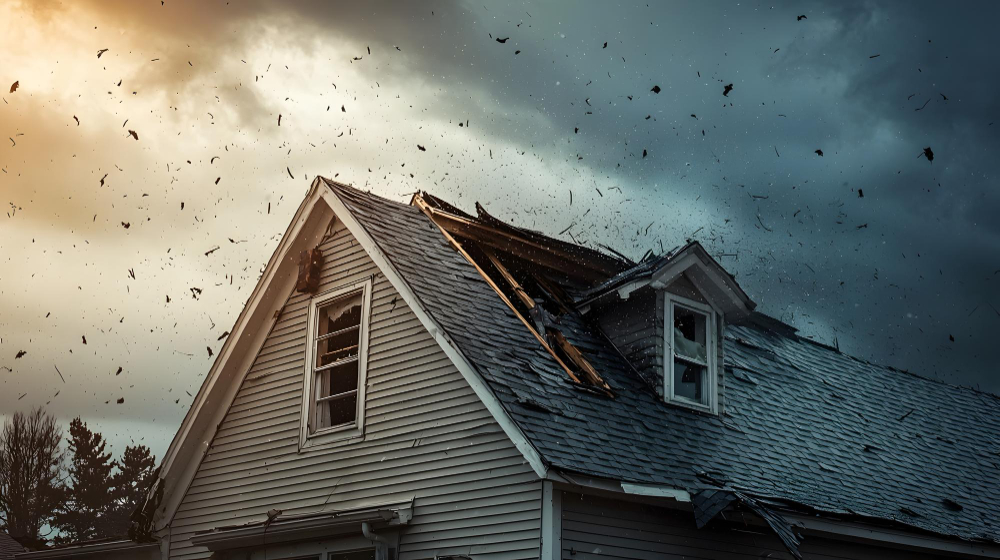
Storm damage tends to be abrupt and patterned. Hail leaves impact bruising with displaced granules, often concentrated on the slopes facing the storm. Wind damage usually shows creasing or missing shingles along edges and ridges. Age-related wear is gradual and uniform across the whole roof.
After a significant storm, photograph what you can see safely from the ground and note the date. That documentation is useful whether or not a claim follows. Gibbs can inspect, document visible damage, and explain findings, and handles storm damage roofing work across Metro Atlanta. Coverage decisions, though, belong to your insurer and your policy, not to a contractor. If you are working through that process, the insurance documentation support page explains what we can and cannot do.
One caution worth stating plainly: not every hailstorm damages every roof, and visible roofing storm damage repair needs are not always present just because a storm passed through. An honest assessment sometimes concludes the roof is fine.
Who to Call for Ceiling Water Damage
For ceiling water damage caused by a roof leak, a roofing contractor is the right first call. The reason is sequencing. A ceiling water damage repair expert can replace drywall, but if the entry point above is still open, the new ceiling will stain too. Water has to be stopped at the source before interior repairs make sense.
Start with roof leak detection and repair to find and seal the entry point. Interior work, including any leaking ceiling repair or ceiling water leak repair, follows after the roof is watertight. If water is actively running into the home, that is when urgent roof response is appropriate, with full repairs scheduled once conditions allow.
If the leak traces to a wall rather than the roof, the path may run behind the cladding instead. That points toward siding repair, soffit and fascia repair, or exterior weatherproofing work, depending on what the inspection finds.
When a Professional Water Damage Inspection Makes Sense
A water damage inspection is worth scheduling when you see any sign of intrusion, after a severe storm, before buying a home, or when a roof passes roughly fifteen years without one. A trained water damage inspector can access the attic, examine flashing and penetrations up close, and assess water damage in places a ground-level look will always miss.
A thorough water damage home inspection should produce written findings with photographs, organized by what needs attention now and what can be monitored. That record is useful for maintenance planning, resale disclosure, and insurance conversations.
If you have noticed any of the signs of water damage described here, a professional roof inspection will identify the source before you commit to a scope of work.
Repair or Replace?
This depends on where the water is entering, how widespread the deterioration is, and the condition of the decking underneath. Isolated flashing failure on an otherwise sound roof is a repair. Multiple leak points, soft decking across several areas, or widespread granule loss on an aging roof push the conversation toward replacement.
No contractor can determine this from a photo. Roof and water damage repair decisions rest on what the roof assembly actually looks like once it is examined. Both roof repair options and roof replacement considerations stay on the table until an inspection narrows it down.
If something on your roof or ceiling has you concerned, schedule an exterior assessment and get a clear answer before the next storm arrives.
Frequently Asked Questions
Water is leaking from my ceiling, who do I call first?
Call a roofing contractor first if the leak appears after rain or sits below a roof plane. The entry point has to be sealed before drywall or paint work will hold. If water is running freely, place a container underneath and contact a roofer the same day. A plumber is the right call instead when the leak appears under a bathroom or kitchen and is unrelated to weather.
How long can a small roof leak go unnoticed?
Often several months. Water can soak insulation and decking well before it stains a ceiling, particularly in a vented attic where some moisture evaporates between rain events. This delay is why annual attic checks catch problems that ground-level inspections miss entirely.
Does a water stain on the ceiling always mean I need a new roof?
No. Many stains trace to a single failed pipe boot, a length of flashing, or a gutter backing up at the roof edge. Those are repairs. Replacement enters the conversation when there are multiple entry points, soft decking across several areas, or widespread shingle deterioration on a roof already near the end of its service life.
What affects the cost of fixing roof water damage?
The main factors are how far the water traveled, whether decking or framing was affected, roof pitch and access difficulty, the number of entry points, and the materials involved. Interior finishes add separate cost. Residential storm damage repair involving multiple slopes generally runs higher than an isolated flashing repair, which is why an on-site assessment is needed before any figure is meaningful.
Should I get my roof inspected after a storm even if I see no damage?
It is worth doing after significant hail or high winds. Impact bruising and lifted shingles are frequently invisible from the ground, and documenting the roof’s condition soon after a storm is useful if damage surfaces later. An inspection may also confirm the roof is sound, which is a legitimate and useful outcome.